Alamance County Arts Councilthe Captain White House213 South Main Streetgraham Nc 27253
A GLANCE AT THE PAST:
History of THE Alamance Arts Council
November 1956 marked the beginning of the Alamance Canton Arts Council. There is little written history nigh this humble beginning, but the local Community Council helped to establish the art association. Ane of the start homes for the Arts Council was the McDade Museum building in Burlington.
In 1966, the metropolis of Graham leased the erstwhile Burn down Hall to the Arts Council. It was called the Firehouse Galleries. There information technology remained for another two decades until more extensive remodeling occurred in 1985. Ceilings were lowered, tract lighting was added, and the walls were covered with cloth so that visual art could exist hung.
The Alamance Canton Arts Council moved into its current home in 1998 later extensive renovation of the Captain James and Emma Holt White Business firm on S. Principal St. in Graham. The $750,000 price helped to ensure the integrity of the historical domicile, which was built in 1873, while updating the electrical, plumbing and heating/cooling systems.
This year marks the 24th anniversary of the Arts Council in the Captain White Firm.
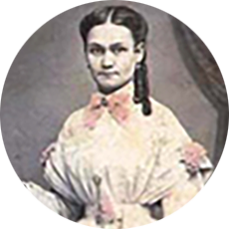
Captain James Wilson White and Emma holt house

1871
Subsequently the Civil War, Helm James Wilson White, Co. "H," first Carolina Calvary, returned home in Fort Mill, Southward Carolina, to assistance run his father's plantation. The main crop was cotton.
In Alamance Canton, the textile industry was growing, creating a good market for cotton fiber. Captain White decided to come up to Alamance County to sell his cotton to the mills run past Edwin Michael Holt. While in Alamance Canton, Captain White met and roughshod in love with Due east.M. Holt's youngest girl, Emma Virginia. The handsome couple married on April 26, 1871.
1873
E.Thou. Holt loved his daughters and didn't want to see them movement away from Alamance County. To proceed them near habitation, he congenital each one a large house on property he endemic on South Main Street in Graham. The firm for Emma and Helm James White was completed in 1873. The style is Queen Anne Revival, though Victoria was Queen of England at the time. The house had the symmetry and practicality of an earlier flow, having fewer decorations that characterized the architecture of the fourth dimension.
The White House originally had 9 rooms plus large forepart and back halls and porches. Later, another room was added on the s side, along with a balcony. The house was of wooden frame and clapboard siding. Rising four feet higher up the ground level, the foundation was of brick covered with stucco. The roof was slate except for the addition, which was copper.

1890
Lighting in the firm was originally by candles and lamps until the 1890's, when the "Gaslight Era" arrived. Gas fixtures were added to each room. When electricity came to Graham in 1905, the house was wired. The wires were open to view and fastened to ceramic insulators nailed to the walls. The controls were rotary or knife switches on the walls or by pull cords with switches at the base of operations of the bare or shaded bulbs. Some of the original wiring can still be seen in the closets. When the business firm was renovated in 1927, the wiring was placed backside the walls.

1920
Heating went from fireplaces to called-for woods, and later coal. In the early 20'south, "vapor heat" was installed. A coal-fired boiler that heated water at a reduced pressure produced this type of estrus. Then the steam "vapor" was piped to the radiators in the rooms. In the 1930's, an "Iron Fireman" was installed to alleviate the constant stoking and cyberbanking of the fire.
Directly in the back of the main house, a small retainer's house was provided. There were also two fenced-in barns and two tenant houses. Besides the servant'south house, the other outhouse was the schoolhouse. When the children grew upwardly and went off to schoolhouse, the building was used for storage. The schoolhouse was destroyed during a storm when an oak tree vicious and crushed it.
1927
The floors were originally wide lath pino planks; some of these nevertheless remain upstairs. In 1927, the firm was remodeled and narrow hardwood floor was laid on top of the pine. The hearths and fireplaces were made of imported tiles and the mantles were faux painted to look like marble. In the back of the house was an "L" shaped back porch. From here, doors opened to the kitchen, dining room and back hall, and later, the downstairs bath. A trap door on the floor led to a pocket-sized basement. The McClures, later, included the porch into what is now the den. At some time, a one-story improver was added to the south side of the business firm, possibly in the 1880's when Emily Farish Holt came to live with her girl's family unit. The new improver had a large bedroom, bath and closets, along with a separate chimney and fireplace congenital on the south side.

As one enters the front door, the large forepart hall is but inside. Squared wooden arches open from the hall into the living room (left), the parlor (right), and the back hall (rear). In the by, these openings had been closed with heavy chaw drapes hung under cornices. The walls had been used to hang large family portraits, mirrors and game trophies. The ceilings vary from x to 14 feet high with the original plaster moldings around the low-cal fixtures. The living room contained a built-in bookcase in one corner and a large, ornate, drinking glass front bookcase in some other corner. This bookcase was affectionately called "the matter." By the built-in bookcase was the "Poppa Bear" chair reserved for the man of the house. The family clock, kept on the pall, was wound each calendar week only before Sunday schoolhouse. While the living room served as the general living surface area, the parlor wasn't used much. The parlor was more formal and independent items like their Steinway infant chiliad piano, a large gold-framed mirror, piece of furniture and a carmine mahogany Victrola phonograph with gold leaf scrolls.
The back hall had doors opening to the dorsum porch, dining room, and the dressing room. The landing in the staircase was large enough to concord a granddad clock and a spinning wheel. Beside the staircase was a chest for linen storage and a hat rack. A telephone tabular array by the cove held the phone #514, in which the ring could be heard throughout the unabridged house.

1930
During the renovations of 1927, a switch was placed in the floor connected to a bell in the kitchen. The switch was pressed with the foot to summon people to the table. In the corner of the kitchen was a pantry where the icebox was kept, until the "real" refrigerator was installed. Originally, to melt food at that place was a fireplace in the kitchen. Then, a wood and/or coal called-for stove was placed in front of the fireplace and vented through the flue. The range was a huge iron monster made by "Imperial." In the early on 1930's, an electric stove was added. Now, the kitchen has been modernized with new cabinets, floor and upwardly-to-date appliances.

1945
After Earth War Ii, Griffen and Elizabeth McClure who had lived across the street, acquired the property and moved into the White House. The garden land had been sold and two houses were congenital at that place. They made many changes to the house, such as closing the two south windows in the downstairs sleeping accommodation, incorporating the back porch into a small den, and replacing the double front door with a single door with a transom window above it. They demolished several of the outhouses, removed the concrete cap on the sometime well and filled information technology in. The kitchen was completely rebuilt and the fences and "rockery" were eliminated.

1950
The original color of the house was yellowish with white trim, later to be painted white with dark green blinds. All windows were double-hung and rectangular except for the Gothic window in the front center. The original forepart door was double, with narrow beveled glass windows on each side. When the McClure family bought the house in the 1950's, they inverse it to a single door with an arched transom window above. The side windows remained the same.
1990
The McClures lived in the house until their deaths, where they raised their three children; Elizabeth, Martha and James. Both of their daughters, Mary Elizabeth McClure Phillips and Martha McClure Hathaway were married in the White House. Later on the deaths of Griffen and Elizabeth McClure, their daughter, Mary Elizabeth McClure Phillips, lived in the house until 1990, when it was sold to the town of Graham.
Source: https://www.alamancearts.org/history
0 Response to "Alamance County Arts Councilthe Captain White House213 South Main Streetgraham Nc 27253"
Post a Comment